


On this page
Key Takeaways
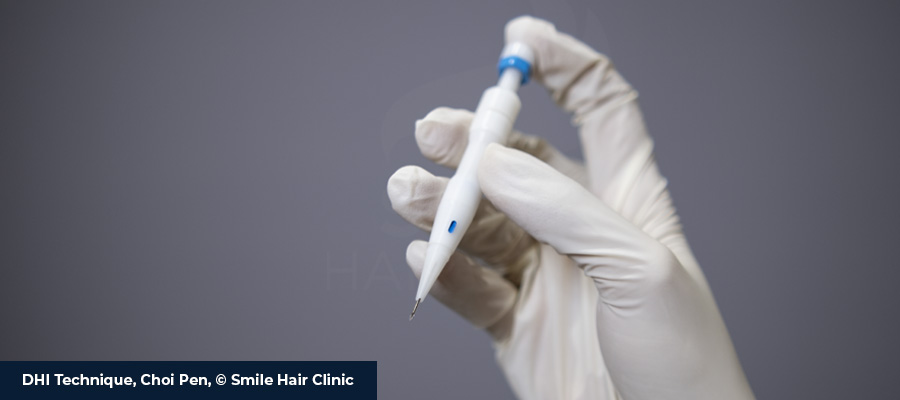
A Choi implanter pen: the tool that defines a DHI hair transplant.
DHI is the hair transplant technique with the most confident marketing. You will read that it gives more density, faster healing, no scars and almost perfect graft survival. Some of that is true in the right case. Some of it is not true in any case. And very few clinic pages tell you when DHI is the wrong choice.
I use DHI regularly, mostly for hairlines, temples, women and patients who do not want to shave. On this page I explain how the Choi pen works, what DHI really changes, when I choose it and when I do not, how it compares with FUE and Sapphire FUE, and what recovery, risks and cost look like. For the wider picture, see my hair transplant techniques page.
What Is DHI Hair Transplant?
DHI stands for direct hair implantation. It is a form of FUE (follicular unit excision) in which the grafts are placed with a Choi implanter pen. The pen holds one graft inside a hollow needle. When it is pushed into the skin, the needle creates the channel, and the graft is released into it in the same movement. That is the ‘direct’ in direct hair implantation: the channel is not opened in advance.
The Choi Implanter Pen: How It Works
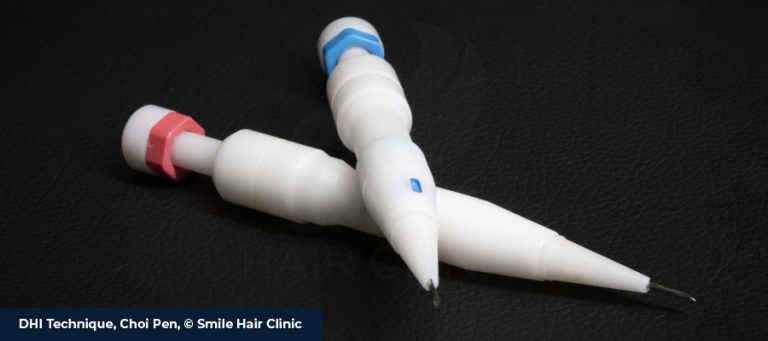
Choi pens come in different needle sizes, matched to the size of each graft.
The implanter was introduced by Dr. Choi in South Korea in 1992. It was designed for Asian hair, which is usually straight and thick and grows mostly in one- and two-hair units. With the spread of FUE, whose grafts are more delicate than those cut from a strip, implanter pens became popular worldwide, as a review in Facial Plastic Surgery (Speranzini and Souza, 2023) describes.
Matching the needle to the graft
Choi needles come in different diameters, usually from about 0.6 to 1.0 mm. Single-hair grafts for the very front of the hairline go into the finest needles; two-hair grafts into slightly wider ones; and three- and four-hair grafts into the widest. A needle that is too narrow squeezes the graft; one that is too wide makes a larger wound than needed. During the operation several pens are used in rotation: while I place a graft with one pen, my team loads the next.
Why angle and depth are in the surgeon’s hand
With a Choi pen, the angle, direction and depth of each channel are decided in the moment the needle enters the skin. There is no separate stage to check the pattern of channels before grafts go in. That gives very fine control in a small area, but it also means every single placement depends on the person holding the pen.
What DHI Changes, and What It Doesn’t
Most of the claims about DHI come from one real difference: the channel and the graft are handled in a single step. Here is what that does and does not mean for you.
What DHI changes
What it does not change
DHI also adds a step that is rarely mentioned: every graft has to be loaded into a pen. That is extra handling, and it takes time. Whether DHI protects grafts better than forceps depends on how carefully the pens are loaded and used, not on the device itself.
When I Choose DHI, and When I Don’t
I do not offer DHI as a better or premium version of FUE. I choose it when the case calls for what the pen does well.
I often choose DHI for
I usually choose something else when
Very often the answer is both: DHI for the first rows of the hairline and the temples, and sapphire channels behind them. That combination gives me the precision of the pen where it is most visible and the speed of Sapphire FUE where the area is largest. Read more on my Sapphire FUE hair transplant page.
The DHI Operation, Step by Step
A DHI operation usually takes about six to eight hours under local anaesthesia, depending on the number of grafts. You are awake and comfortable, and most patients rest or watch a film.
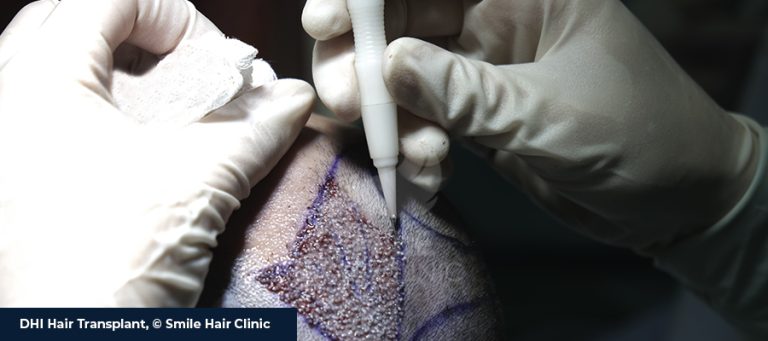
Grafts are placed one by one with the Choi pen, following the hairline drawn before surgery.
DHI vs FUE vs Sapphire FUE
All three use the same extraction. They differ in how the channels are opened and how the grafts are placed.
DHI vs FUE: which is better?
Neither is better for everyone. In FUE, all channels are opened first, so I can see and adjust the whole design before a single graft goes in, and placement with forceps is fast. In DHI, each graft is placed as its channel is made, which gives fine control and close packing in a small area and lets grafts go between existing hair. At 12 months, a well-planned DHI hairline and a well-planned FUE hairline can look identical. The plan and the hands matter more than the method.
DHI vs Sapphire FUE
These are the two techniques I use most, and I often use them together. Sapphire FUE is my choice for large areas and big sessions; DHI is my choice for the finest work at the front and for unshaven cases. If you are deciding between them, the better question is which zones of your head need which kind of precision. In this video a couple from the United States talk about having one of each.
Video: a couple from the US compare their DHI and FUE experiences.
Unshaven DHI: Possible, With Limits
Because the Choi pen can place grafts between existing hairs, DHI is the technique most often used for an unshaven hair transplant. The recipient area is left as it is, and the donor area is either shaved in narrow strips hidden under longer hair or not shaved at all.
The limits are real. Extracting and placing grafts between long hair is slower, so fewer grafts can be moved in a day. Unshaven DHI suits early to moderate hair loss, a hairline refinement or adding density, rather than covering a large bald area. If you need many grafts, I will tell you honestly whether an unshaven plan is realistic. See my unshaven hair transplant page for more, and this video of an unshaven operation I performed.
Video: an unshaven hair transplant with Dr. Gökay Bilgin.
DHI for Women
Hair loss in women usually looks different from male pattern loss. Rather than a receding hairline with bald areas, most women have thinning over the top and the parting, with hair still present, or a high hairline. DHI suits these cases well, because grafts can be placed between the existing hair without shaving it and without damaging it.
Women need careful selection. The pattern should be stable, the donor area at the back should be dense and not thinning itself, and medical causes such as thyroid problems, iron deficiency or hormonal conditions should be checked first. A female hairline is also designed differently: rounder, without deep temple corners, and usually kept at its natural height.
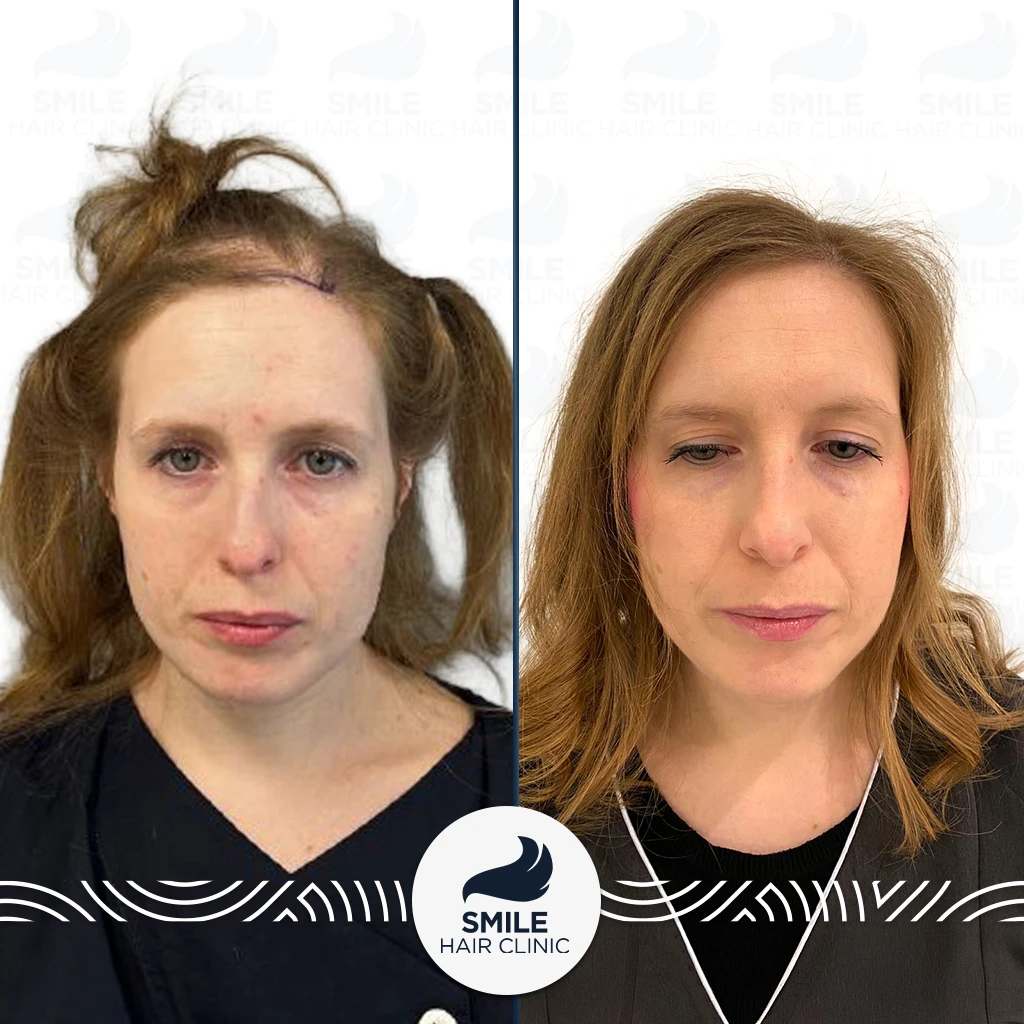
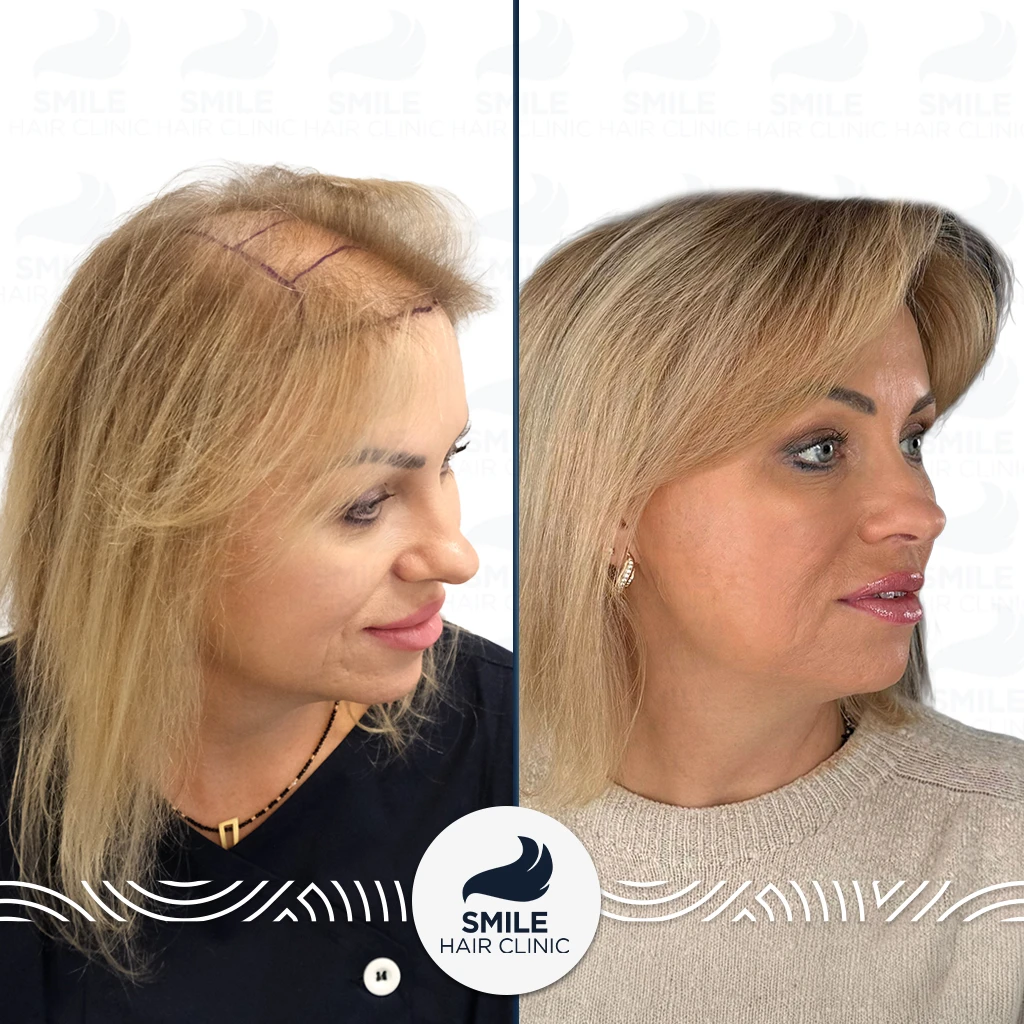
Results vary from person to person. You can read more about candidacy, planning and recovery for women on my female hair transplant page.
Female hair transplant is one of the fastest-growing areas of hair restoration: the ISHRS 2025 Practice Census reported a 16.5% rise in female surgical patients between 2021 and 2024.
Who Is a Good Candidate for DHI?
Usually a good fit
- Men with early to moderate hair loss, mainly at the hairline and temples.
- Women with stable thinning and a strong donor area.
- Patients who prefer not to shave the recipient area.
- Eyebrow and beard transplants. See beard transplant.
- Adding density to a previous transplant.
- Curly and Afro-textured hair, with careful extraction. See Afro hair transplant.
When DHI alone is not the best plan
- Advanced hair loss (Norwood 5–7) needing a very large session: usually Sapphire FUE, often with DHI at the front.
- A weak donor area: beard or body hair may be needed. See body hair transplant.
- Very young patients or fast, unstable loss: medical treatment first. See hair loss treatments.
- Active scalp disease, uncontrolled diabetes, bleeding disorders or unrealistic expectations.
- I do not operate on patients over 65.
DHI Recovery and Results Timeline
Recovery after DHI follows the same biology as any FUE. When the recipient area is unshaven, the existing hair also helps hide the healing scalp in the first days.
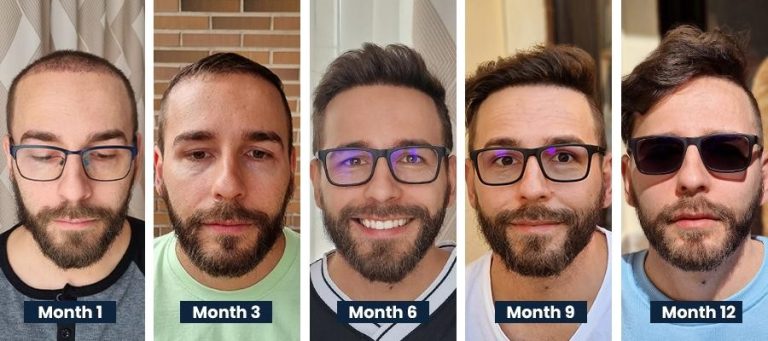
One patient’s progress after DHI at the hairline, from month 1 to month 12.
In this short video you can see a 6-month result after 4,000 grafts with DHI, from one of my cases.
Video: 4,000 grafts with DHI, 6 months after surgery.
Risks and Side Effects of DHI
DHI is a safe operation when it is planned and performed well, but it is surgery. These are the side effects I explain to every patient.
How Much Does a DHI Hair Transplant Cost?
In Turkey, DHI is usually sold as an all-inclusive package. In the UK and the US, the price is usually for the procedure alone. Many clinics charge more for DHI than for FUE because it is slower and needs more pens and staff. These are typical 2026 ranges.
A higher price for DHI is only worth paying if it buys something real: a doctor who holds the pen, enough time per graft, and a technique that suits your case. If the premium is only for the name, it buys nothing.
For everything that is and is not included, see my Turkey hair transplant cost guide, and for prices by number of grafts, my graft cost page with its calculator.
Five Questions to Ask a Clinic That Offers DHI
My guide to hair transplant in Turkey explains how to check a clinic and what the law requires.
Frequently Asked Questions About DHI Hair Transplant
Is DHI better than FUE?
DHI is a form of FUE that places grafts with a Choi pen. It is excellent for hairlines, temples, women and unshaven cases. Classic or Sapphire FUE is faster and more flexible for large sessions. There is no proven difference in graft survival, and at 12 months both can look the same when they are well planned.
Is DHI hair transplant painful?
The local anaesthetic injections at the start are the most uncomfortable part. After that, most patients feel only pressure. Some tightness and discomfort for a few days afterwards are normal and are controlled with medication.
Do I have to shave my head for DHI?
Not always. The recipient area can often stay unshaven, and the donor area can be shaved in hidden strips. For larger sessions, shaving usually gives a safer and more even result.
How many grafts can be transplanted with DHI in one session?
It depends on your donor area and on the time available, because DHI is slower per graft. For very large sessions I usually combine DHI at the front with Sapphire FUE behind it, or plan two sessions.
What is the graft survival rate with DHI?
Good technique usually gives high survival with any method, but no clinic can honestly guarantee a percentage, and there is no good evidence that DHI grafts survive better than well-placed FUE grafts.
Does DHI leave scars?
The donor area heals with small dot scars, the same as any FUE, usually invisible unless the hair is shaved very short. The recipient area heals without visible scars.
How long does DHI take to heal?
The donor area usually heals in 7–10 days and the crusts on the recipient area clear in 10–14 days. The transplanted hair sheds, starts to regrow around months 3–4, and the final result takes 12–18 months.
Is DHI good for women?
Often, yes. Most women have thinning between existing hair, and DHI lets grafts go in without shaving or damaging that hair. Careful selection and checking for medical causes come first.
Why is DHI more expensive at some clinics?
It is slower, uses more pens and needs more staff time. A higher price is reasonable if it pays for more doctor time on your case. My Diamond package costs the same whichever technique we use.
Is DHI permanent?
The transplanted hair comes from the permanent donor area and keeps growing for life. Your native hair around it can continue to thin, which is why medical treatment is often part of the plan.
Find Out Where the Pen Makes a Difference
Send me photos of your hair from the front, top, sides and back. I will tell you whether DHI, Sapphire FUE or a combination suits you, how many grafts I would plan and whether an unshaven procedure is realistic.Get a Free Consultation